LGBTQ+ community planning
Make room for your next community outing
Plan an LGBTQ+ meetup, Pride visit, or quiet community evening with clear questions and a budget you control.
This guide helps you prepare for an event. The calculator uses your own costs and runs in your browser. The site offers no live event listings, venue endorsements, or AI chat.
Choose the kind of connection you want
Start with the experience you want: a conversation, a creative activity, a discussion group, or a celebration. Decide whether you prefer a daytime gathering, an alcohol-free setting, or a smaller group. Search for that activity alongside your town and LGBTQ+ community terms.
Before inviting friends, ask whether newcomers can attend alone and whether a host welcomes people at the entrance. Check the event's intended audience and age policy. Ask how the organizer handles harassment. A rainbow image alone gives you little information about these practical details.
Check the details at their source
Use the organizer's current announcement to check the date, start time, address, ticket conditions, and cancellation arrangements. Match the venue address against the venue's own information. If announcements disagree, ask the organizer before booking travel. Save the confirmed details somewhere you can read without a connection.
If you use artificial intelligence, or AI, to suggest activities, check its suggestions independently. The National Institute of Standards and Technology describes confident but false AI output in its Generative AI Profile, NIST AI 600-1 (2024), section 2.2. Treat an AI suggestion as a starting point for your own checks.
Free local calculator
LGBTQ+ event budget calculator
Enter your own estimates in US dollars. Tickets and food apply to each person. Transport and the reserve apply to the whole group. Include booking fees in your ticket estimate. Use the reserve for costs you want to allow for, such as an alternative journey home.
Method: group budget = people × (ticket + food) + transport + reserve. The equal share rounds up to the next cent. Actual spending can differ. This is a planning estimate, not a price quote. The calculator sends no inputs and saves no inputs.
Agree on shared costs before the outing. An equal split is only an illustration; discuss a different arrangement if people have different budgets. Keep the return journey in your plan even when admission is free.
Ask concrete questions about access
Ask about the route from the entrance to the activity and restroom. Request details about steps, lifts, seating, lighting, noise, and a quiet place to pause. Describe the access information you need without sharing a diagnosis. Ask about captions or interpretation when these matter to you.
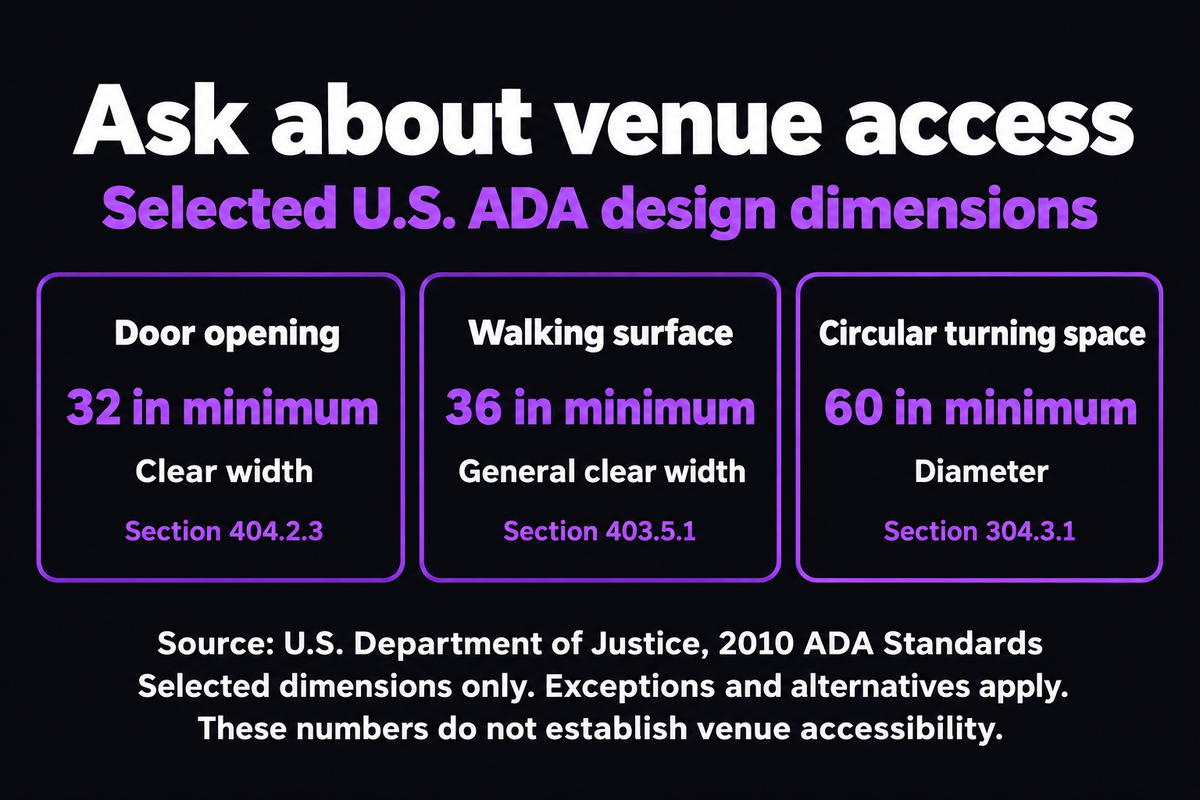
The U.S. Department of Justice's 2010 ADA Standards for Accessible Design give useful reference dimensions. ADA means Americans with Disabilities Act. Section 404.2.3 gives a minimum door opening clear width of 32 inches. Deeper openings have additional requirements. Section 403.5.1 gives a general walking surface clear width of 36 inches, with exceptions. Section 304.3.1 gives a circular turning space diameter of at least 60 inches; a compliant T-shaped space is an alternative.
These selected dimensions do not establish that a venue meets the standards or suits your needs. Ask the organizer about the actual event layout. Furniture and queues matter as well as the building.
Keep control of your participation
Ask whether the event includes photography and how to opt out. Tell friends before they tag you or share your location. Use the name and pronouns you want to share. You can decline a question about your identity or personal history.
Agree on a meeting point if you attend with someone. Check the return service before leaving home. Keep the organizer's contact details available. Give yourself permission to leave early or change the plan. Afterward, note what worked for you so your next outing starts with fewer unanswered questions.